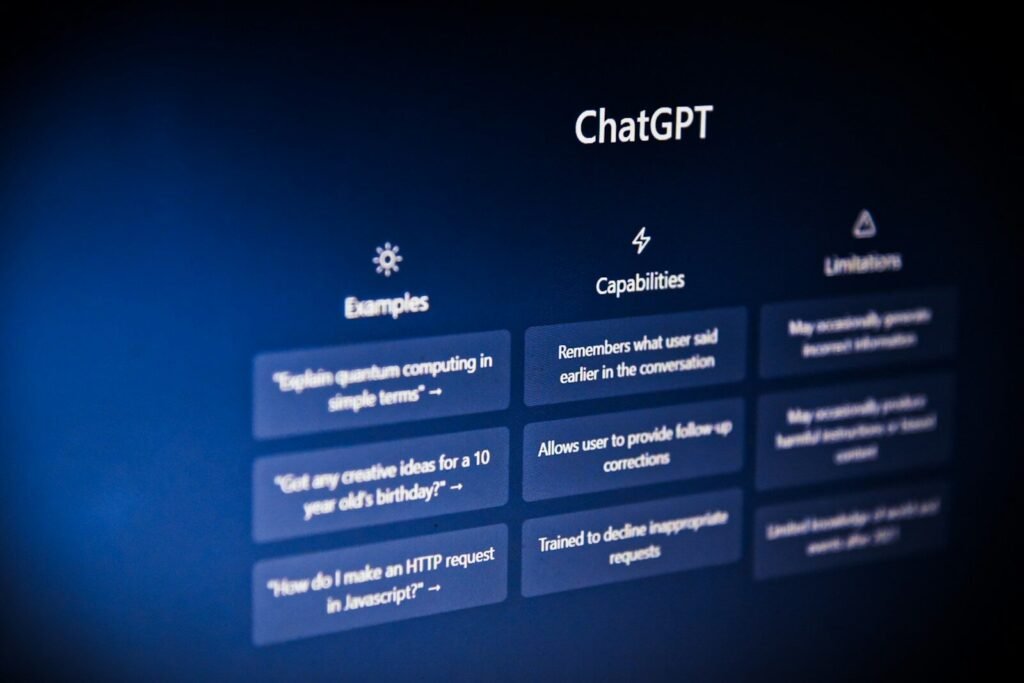
ChatGPT and Claude are both powerful AI assistants, but they are built with slightly different strengths. OpenAI currently positions ChatGPT as a tool for writing, brainstorming, editing, summarizing meetings, generating and debugging code, and boosting productivity, while Anthropic positions Claude around long-context work, agentic tasks, coding, and careful analysis.
What Is ChatGPT?
ChatGPT is OpenAI’s chatbot. OpenAI lists writing, brainstorming, editing, exploring ideas, summarizing meetings, generating and debugging code, and answering complex questions as some of the use cases for ChatGPT on its overview page. OpenAI’s current ChatGPT plans also include GPT-5.5 Thinking, longer messages and uploads, advanced research and agent mode, longer memory and context, projects and tasks, custom GPTs, and more Codex usage.
For people who want an all-purpose assistant that can move quickly between content creation, coding help, and everyday work, ChatGPT is built to cover a very broad set of tasks in one place.
What Is Claude?
Anthropic’s AI family is called Claude and Anthropic claims it is a family of advanced large language models. As of today, its pricing page offers Free, Pro, Max, Team, and Enterprise versions, and its model options are Opus 4.7, Sonnet 4.6 and Haiku 4.5. Anthropic claims that Opus 4.7 is the smartest model for agents and code, Sonnet 4.6 is the smartest, fastest and most cost-effective model, and Haiku 4.5 is the fastest and cheapest model.
Anthropic has also highlighted long-context capability in its Opus line, including Opus 4.6’s 1M-token context in beta and 128k output tokens, and it says Opus 4.7 delivers stronger long-context performance and better results on complex multi-step work.
ChatGPT vs Claude: Which One Is Better?
The better choice depends on how you work. Based on their current official product positioning, ChatGPT is the more flexible everyday assistant, while Claude is especially strong when the task involves long documents, multi-step reasoning, and careful analysis.
1. Speed and Everyday Use
ChatGPT is a strong choice for fast, day-to-day use because OpenAI emphasizes quick help with writing, summaries, coding, and general productivity. That makes it a practical option for users who want one assistant that can handle many different tasks without slowing down the workflow.
Claude is also designed for high-quality responses, but Anthropic’s current model positioning focuses more on deliberate, structured work and sustained multi-step tasks. That makes Claude feel especially suited to deeper tasks rather than rapid-fire everyday prompts.
2. Writing Quality
For writing, ChatGPT is a strong all-rounder because OpenAI explicitly highlights brainstorming, editing, and creative exploration. That makes it useful for blog outlines, email drafts, social captions, and quick first drafts.
Claude is often the better fit when the writing needs to feel more structured, careful, and polished across long passages. Anthropic’s emphasis on long-context performance and multi-step work makes it a natural choice for articles, reports, and documents that need consistency from start to finish.
3. Coding and Technical Work
ChatGPT is clearly designed for coding help, and OpenAI specifically calls out generating and debugging code, learning new APIs, and automating repetitive tasks. For many users, that makes it an excellent companion for quick technical problem-solving.
Claude is also very strong in technical work, and Anthropic now positions Opus 4.7 as its most intelligent model for agents and coding, with stronger results on complex coding workflows and multi-step tasks. For longer technical jobs, that makes Claude a serious contender.
4. Long Documents and Deep Research
Claude has a clear advantage when the job involves reading and reasoning over very large amounts of text. Anthropic has published long-context capabilities in its Opus line, and its recent model notes highlight stronger long-context performance and multi-step reliability in Opus 4.7.
ChatGPT has also improved a lot in this area, especially with expanded context and deep research features in current plans, but Claude remains the better fit when a task depends heavily on sustained document understanding.
Which AI Is Better for Bloggers?
When it comes to blogging, ChatGPT is generally the best assistant for writing, editing, brainstorming, summarizing, and rapid content creation. It is particularly good for outlines, writing intros, sourcing titles and rewriting content for other media.
Claude is a strong choice when a blog draft needs more structure, more careful reasoning, or a deeper review of a long source document. Its long-context positioning makes it especially useful for research-heavy posts and detailed editorial work.
Final Verdict
There is no single winner for everyone. ChatGPT is the stronger all-around assistant for fast writing, productivity, and coding help, while Claude is the better choice for long documents, deep analysis, and sustained multi-step reasoning.
The smartest choice is to match the tool to the task. If the goal is speed and versatility, ChatGPT is usually the easier pick. If the goal is careful reading, large-context analysis, and complex workflows, Claude has the edge.
FAQ
Is ChatGPT better than Claude for writing?
ChatGPT is a strong choice for fast drafting, brainstorming, and editing, while Claude is often better for longer, more structured writing tasks.
Is Claude better for research?
Claude is especially well suited to long documents and multi-step analysis, which makes it a strong option for research-heavy work.
Which AI is better for coding?
Both are strong, but ChatGPT highlights code generation and debugging, while Claude’s current Opus 4.7 model is positioned as its strongest option for agents and coding.
Can you use both ChatGPT and Claude?
Yes. Their official product pages show different strengths, so many workflows can benefit from using both tools for different tasks.

About the Author
Ahsan Javaid is a content writer and AI tools reviewer who runs the website https://aireview.it.com/. He specializes in testing AI tools, writing detailed comparisons, and publishing practical guides to help bloggers and online creators make better decisions.
With hands-on experience using tools like ChatGPT and Claude for content writing, research, and SEO workflows, Ahsan shares real-world insights based on actual usage rather than theory.
For collaborations, guest posting services, or inquiries, you can contact him via WhatsApp at +923162383674 or email at ahs7an@gmail.com.
I personally tested both ChatGPT and Claude while creating blog content, rewriting long articles, and generating SEO outlines. In my experience, ChatGPT is faster for generating drafts, while Claude performs better when analyzing and improving long-form content.